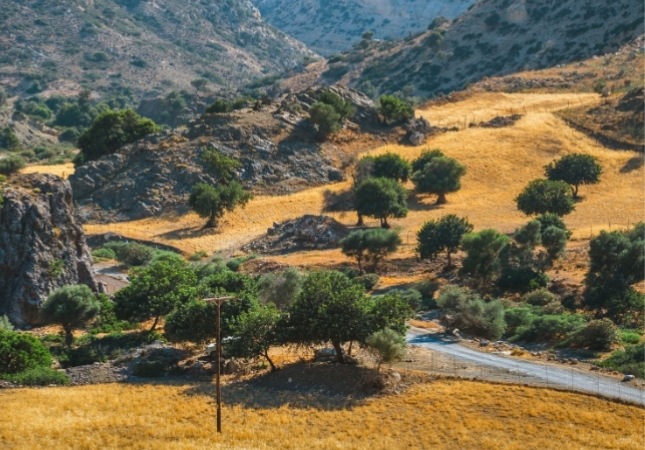
Malles
In the village one can visit the temple of Metamorphosis tou
Sotiros - Ag. Charalampous, a magnificent Basilica which was built in 1848 and is decorated with one of the most beautiful wood carved,
gold covered temples of the area which is said that it was carved then and there, the Cultural Centre and the library, the Abbey of Virgin Mary of Exakousti, the cave of Polynerou as well as the Byzantine churches of Saint Georges and Virgin Mary of Mesochoritissa.
Path E4
The European path E4 after thousands of kilometres of paths and passing through many European countries ends here, in the prefecture of Lasithi, its long as well as magnificent course. The dirt road passes over Malles but not through the village. On the right and on the left there are large pine trees and hollies. On the right and looking down we can admire the Libyan
sea and the city of Ierapetra. We continue on various dirt roads until we meet an asphalt road that leads us to the village of Prina. Leaving Prina we are on the dirt road that takes us to the small village of Messeleri, where the pinewood that accompanied us all the way ends here. We cross the village and we continue uphill on a dirt road passing from the monastery of Vryomenou above the village Stavros.
The dirt road continues until it meets another dirt road that comes from the settlement Asari. Here and under the big oriental plane we can rest and fill our bottles with water.
Selakano
The region of Selakano is a mountainous region at the north west boundaries of the Municipality of Ierapetra, next to Malles and it is one of the most beautiful and most important ecosystems of the island, as well as an important pinewood for all the Mediterranean. A part of the area is covered by forest, mainly of Turkish pine. Here one can also find other types of trees such as the kermes oak, the cypress, maple, oriental plane etc. Splendid canyons, streams, sharp slopes, where you can find falconiformes birds such as golden eagles and falcons. The area is accessible by asphalt road through an enchanting route all the way to the settlement of Selakano as well as by a network of forest roads. There the cave “Neraidogoula” can be found,one of the well hidden secrets of nature for strangers.
Sarakina
West of Ierapetra and at a distance of 20 kilometres the traditional village of Mythi is found. Within a short distance from it you can visit the gorge of Sarakina or Sarantapichou as the locals call it. According to the myth Sarantapichos (a giant, son of Zeus) whilst passing through the mountain bent down to drink some water from the river. His long beard split the mountain in two and that’s how the gorge was created. It is a gorge that is easily accessible, with waters, small lakes and places for climbing. It is ideal for a pleasant afternoon or for a walk with your children. The crossing through the gorge will take you roughly one hour.
Myrtos
This settlement is built amphitheatrically in the estuaries of the river “Kryos”(Cold). The early Minoan settlements on the hills of “ Fournou Koryfi” (2600-2200 B.C.) and “Pyrgos” (1600-1450 B.C.), are the sights of the area to visit, with remarkable architecture and organization as well as important discoveries. Other sights are the Archaeological and Folklore Museum of Myrto, the ruins of the Roman baths and the renovated church of Ag. Antonios.
Metaxochori
Near Malles, in 550m. altitude, it is the birth place of Patriarch Meletios Metaxakis (1871-1935 ), who gave his name to the village
(earlier called Parsas). Meletios Metaxakis was the Metropolitan bishop of Kitios in Cyprus, Metropolitan bishop of Athens with the encouragement of El.Venizelos, Ecumenical Patriarch of Constantinople where he resigned following the Greco-Turkish War and was Patriarch of Alexandria until his death.